
The Cheese Ate Itself: How Bacteria Are Learning to Make Real Dairy Without Cows
- Jun 1
- 5 min read
The 9‑Billion‑Person Question
By 2050, the world will need to feed nearly 10 billion people. Demand for animal protein is expected to increase, especially for milk proteins, which are prized for their nutrition, texture, and versatility. But the dairy industry is under fire: cows produce methane (4% of global greenhouse gases), demands large volumes of fresh water, and require vast land. Enter Precision Fermentation: the same technology used to make insulin, now being harnessed to brew real milk proteins with no barn required.
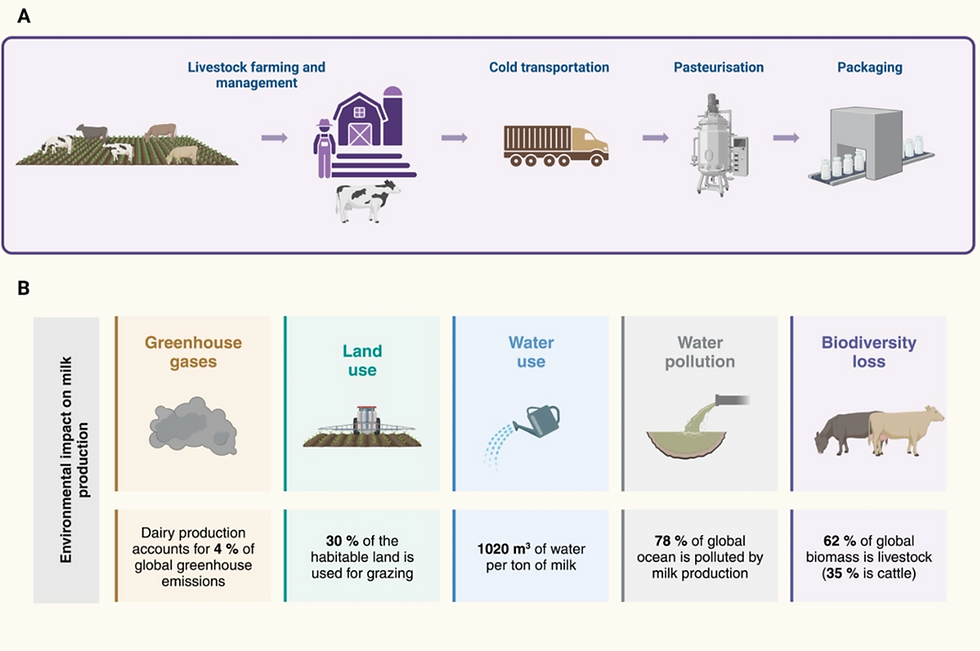
Figure 1. Milk production process and its environmental impacts. A. Traditional milk production process from farm to packaging. B. Environmental impacts on the traditional milk production process.
But it's not that simple. Milk proteins, especially caseins, need a special chemical tag called phosphorylation to work properly. Without it, they can’t bind calcium, form micelles, or make cheese curds. And microbes don’t naturally know how to add that tag.

Figure 2. Milk proteins and their role in dairy – Casein micelle are colloidal particles consisting of αs1-, αs2-, β-, and κ-caseins held together by calcium phosphate nanoclusters. Casein micelles enable functionality in various dairy products such as coagulation, gelation and foaming.
A new PhD thesis from the Technical University of Denmark (2024) shows that we’re closer than ever to solving this problem by using bacterial kinases, phosphomimetic engineering, and bacterial secretome.

Figure 3. Precision fermentation – Recombinant production of food proteins
Part 1: The Whey Problem – Getting Bacteria to Spit Out Protein
The first challenge: secretion. Ideally, you want bacteria to spit out the milk protein into the growth medium. That makes purification easy. But common lab bacteria like E. coli keep proteins inside them.
So the team switched to Corynebacterium glutamicum — a harmless, food‑safe bacterium already used to make amino acids. It naturally secretes proteins into its surroundings.
They inserted genes for two whey proteins (α‑lactalbumin and β‑lactoglobulin) into C. glutamicum and added a signal peptide to guide the proteins out.
Result? The whey proteins came out, but barely.
Cracking Open the Secretome
To understand why, the team performed a label‑free mass spectrometry analysis of everything C. glutamicum secreted. They identified 427 distinct proteins in the culture supernatant, but only 148 had a classical signal peptide. The rest likely came from cell lysis or unconventional secretion.
What is worse is that the top 12 most abundant native proteins made up 80% of the total secretome. The target whey proteins? Just 0.13–0.14%. This is like trying to hear a whisper at a rock concert.
Borrowing the Best Tools
The team noticed that one native protein, Cgl1514, was consistently among the most abundant. Earlier work had shown its promoter and signal peptide are powerful. So they swapped in the Cgl1514 promoter + signal peptide to drive whey protein production.
The result is that there is a dramatic increase in secretion, visible on both SDS‑PAGE and Western blot.
Feeding the Factory – Grass to Protein
But growing bacteria on pure glucose is expensive. To keep costs down, you need cheap, waste‑based feedstocks.
The team turned to alfalfa pulp — a leftover from plant processing. After a simple chemical treatment, it releases a sugar mix containing 35 g/L glucose and 13 g/L xylose.
There's just one problem: wild C. glutamicum can't eat xylose.
So the team engineered the bacteria with two genes from another microbe, allowing them to digest xylose. Then they put the bacteria through adaptive evolution to make them digest faster. The result is that an evolved strain called H4 that grew on xylose almost as fast as on glucose.
Part 2: The Real Challenge – Phosphorylating Caseins
Whey proteins are the easy part. Caseins are harder. To work properly, they need a chemical tag called phosphorylation — added by a cow’s enzyme (Fam20C). Bacteria don’t have that enzyme. The team tried putting the cow enzyme into E. coli. It failed — the enzyme clumped up and died.
Bacterial Kinases to the Rescue
So they borrowed bacterial kinases from B. subtilis and C. glutamicum. They tested four. Two worked beautifully: PrkD tagged all 9 of the correct sites on αₛ₁‑casein ; YabT tagged 8 out of 9.
An Even Smarter Shortcut: Phosphomimetics
What if you skip kinases entirely? The team made a phosphomimetic version of αₛ₁‑casein by swapping the eight target serines with aspartate (an amino acid that carries a negative charge just like a phosphate group).
This variant, called Rαₛ₁‑PM, needed no kinase. And it worked beautifully: Calcium binding (essential for cheese-making) was nearly identical to real casein.
The same trick for β‑casein also improved its calcium binding, though the protein was a bit fragile.
Part 3: Blending with Plants – A Hybrid Future
Could lab-made caseins work alongside plant proteins? The team tested casein with Napin from rapeseed.
Caseins + Napin = Droplets or Clumps
At neutral pH, Napin carries a positive charge. Caseins carry a negative charge. Opposites attract, but the result depends on how strong the attraction is:
Weak attraction → liquid droplets (called coacervates), which are great for emulsions.
Strong attraction → solid clumps (aggregates), which are less useful.
The team then mixed Napin with each casein variant and looked under a microscope.
These are what they observed:
Interaction Between Napin and Different Casein Variants
Casein Variant | Type of Assembly | Outcome for Food Use |
Real bovine α‑casein | Liquid droplets (coacervates) | Good (emulsions, stability) |
Phosphomimetic (Rαₛ₁‑PM) | Liquid droplets (coacervates) | Good (emulsions, stability) |
PrkD‑phosphorylated (Rαₛ₁‑PD) | Solid clumps (aggregates) | Poor (too sticky, precipitates) |
YabT‑phosphorylated (Rαₛ₁‑YT) | Small liquid droplets | Acceptable (limited but usable) |
Unphosphorylated (Rαₛ₁) | Barely any interaction | Not useful (no complex formation) |
What’s Still Missing?
This is groundbreaking work, but it’s not yet ready for the grocery store.
Key challenges remain:
Yield | Even with optimized promoters, yields are far below industrial scale (grams per liter vs. kilograms). |
Inclusion bodies | A large fraction of casein still aggregates in E. coli. Strategies to boost soluble fraction are needed. |
Regulatory & consumer acceptance | GMO‑derived foods face hurdles, especially in Europe. |
The Bigger Picture
Despite these hurdles, the thesis demonstrates a clear proof of concept:
Bacterial kinases can phosphorylate recombinant caseins at native sites.
Phosphomimetic design can bypass kinases entirely, offering a simpler production route.
Secretome analysis provides a roadmap for engineering better bacterial hosts.
Recombinant caseins can interact with plant proteins, opening the door to hybrid dairy‑plant products.
The next decade will likely see a shift: from “milk from cows” to “milk from microbes” as a viable, sustainable choice. Not to replace traditional dairy overnight, but to offer an alternative that is kinder to the planet, animals, and perhaps our own health.
And it all started with a few bacterial kinases and a scientist asking: What if we could brew cheese?
Citation
Balasubramanian, S. (2024). Precision fermentation of milk proteins [PhD thesis, Technical University of Denmark]. DTU Orbit. Balasubramanian, S., Kohler, J. B., Jers, C., Jensen, P. R., & Mijakovic, I. (2024).
Exploring the secretome of Corynebacterium glutamicum ATCC 13032. Frontiers in Bioengineering and Biotechnology, 12, Article 1409405. https://doi.org/10.3389/fbioe.2024.1409405
Vestergaard, M., Chan, S. H. J., & Jensen, P. R. (2016). Can microbes compete with cows for sustainable protein production? A feasibility study on high quality protein. Scientific Reports, 6, Article 36421. https://doi.org/10.1038/srep36421
This article was prepared by Yap Chi Keat (Yonsei University)
Comments