
A Foundation for the Future: Bio-Compatible Substrates as Means to Revitalise Bleached Corals
Introduction
Over the past few years, temperatures have risen to the roof. With extreme weather on the rise, many of the world’s previously fertile regions are now stranded high and dry, either choked in drought or inundated with floods. Likewise, temperatures in London have climbed to 34.8°C on 26 May 2026, provisionally smashing the highest temperature of meteorological springtime on record. And, summer has not even kicked in. It’s crystal clear that heat waves are taking a toll on our quality of lives, yet these are just the tip of the iceberg. The reality of climate change is more than meets the eye.
In reality, climate change takes a toll not only on humans. Transcending scenarios within our quotidian lives, coral reefs beneath the sea are grappling to barely survive. Over the last two years, a record-high 83.7% of the world’s reefs has been loomed over by bleaching-level heat stress. What’s even more concerning, reefs are home to in the region of 25% marine organisms. The reefs are nature in its finest. As corals falter, what we miss are not only its vibrant colour and beauty, but also 1 million of other marine species.
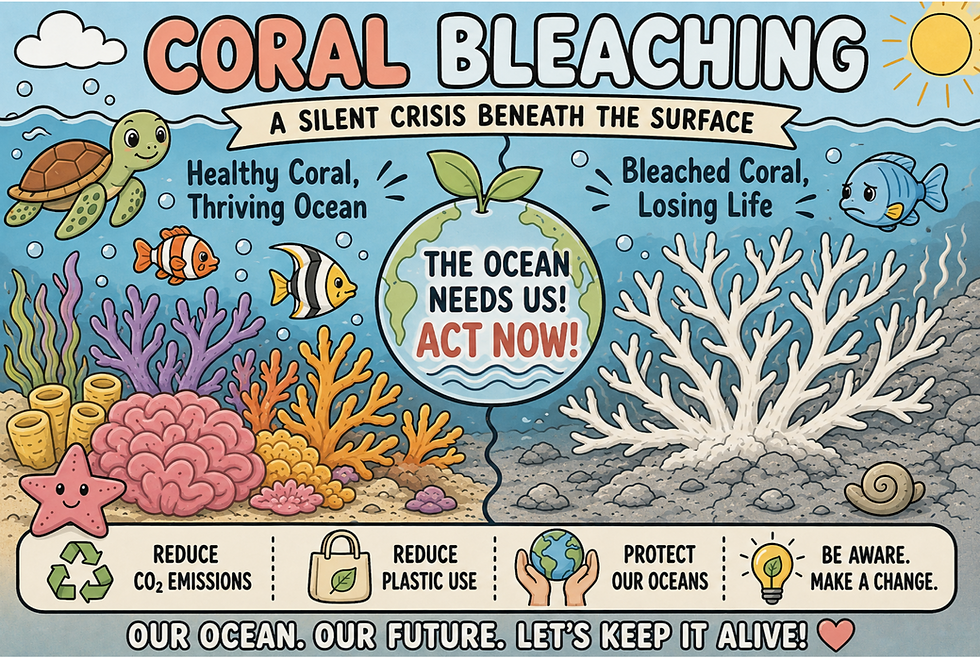
Coral Bleaching
Corals are tiny animals called coral polyps living in symbiotic relationship with microscopic algae called zooxanthellae - much akin to how fungi and algae form lichen. A coral unit can be as small as 0.1cm, yet, together, they make up an enormous reef.
Like it or lump it, corals are extraordinarily sensitive to fluctuations in water temperature. A temperature just 1°C above the local summer maximum can render them haywire. As corals are subjected to heat stress, they expel the zooxanthellae residing within, lose their vibrant colour and expose their inner white skeleton made up of calcium carbonate in an event called coral bleaching. Without the algae, coral loses its source of food and becomes highly susceptible to diseases.
Coral bleaching impacts not only corals, but also many reef animals. In effect, this phenomenon elicits significant repercussions on species relying on reefs for shelter, with many rare species inclusive. As reefs lose their colour, dozens of vibrant tiny reef dwellers find themselves in vain with nowhere to hide, often falling prey to greater predators as a result. At the end of the day, this encroached upon the marine ecosystem. In this sense, coral bleaching spells the thin end of the wedge.
To exacerbate the matter, corals grow remarkably slowly. More often than not, it takes 10 to 15 years for an area of bleached coral reef to fully recover and re-establish naturally, provided that there are no major environmental perturbations - such as another heat wave or intense storms - standing in the way. In the meanwhile, certain endemic species could have been shoved to the brink of extinction, owing to the loss of habitat. As this persists, some exotic creatures may even become eternally unaccounted for, before we even get in time to discover their existence.
Coral Restoration: Artificial Coral Reef
Thinking of the biodiversity loss threatening us, the big picture is rather bleak, admittedly. Nonetheless, we are not doomed to lose our corals should we act fast enough. The Malaysian government has set up marine protected areas, though we necessitate consolidation on surveillance. In conjunction with this, we are lucky to have multiple non-government organisations which are willing to relentlessly run the extra mile in field work - evaluating coral health, monitoring coral growth and the like.
To accelerate reef restoration, science is at the rescue. As humans continuously strive for sophistication in technology, advancements in conservation science have allowed damaged coral reefs to restore their healthy, functional ecosystem within, at best, 3 to 4 years. By and large, artificial structures that support coral reef growth are the golden go-to solution for far and away all coral restoration projects. However, scaffolds far and near come with all sorts of designs and a continuum of materials. In lieu of having a perfect model put in place, each type poses its own merits and drawbacks.
Firstly, concrete is the most common material deployed, owing to its high resistance and adaptability. It can be further modified by adding various elements, say, sand, to tweak the surface texture. Nonetheless, some concrete boasts a pH of 10-11 upon immersion, rendering pH-resistant species (e.g. barnacles) to colonise them before corals have a chance. Switching gears, a handful of conservation groups turn to tyres and plastics in an effort to upcycle wastes. Fair enough, they are trying to minimise their costs while compensating for a large coverage area. Nonetheless, little do they know that this will turn out to be an ecological disaster. Not only do corals find it hard to cling onto such substrates, but tyres and PVC can leach harmful chemicals into the sea, wreaking havoc to the local ecosystem over time. Moving on, some opt for metal structures, accounting for its light weight and malleability. This really comes off as coral polyps readily attach to such structures. Instigated by Mars Incorporated in Indonesia, such modality is exemplified by a conservation project using hexagonal ‘Reef Stars’ (sand-coated steel bars) to attract young corals. Yet, the only shortcoming is that substances released during oxidation can bolster algae growth once immersed. And, organisations which deposit metal wastes at the seabed for this purpose can inadvertently provoke major contamination issues as toxic adulterations such as lead and mercury leach into the sea. Above all, wood is another well-rounded candidate which offsets all aforementioned concerns, considering the fact that it is highly bio-compatible on top of being far and away non-toxic - since its property in high biodegradability comes into play. Paradoxically, however, the downside of this material lies exactly within this same property. Depending on the type of wood used, some degrade so quickly that the wood languishes before corals catch up to settle in.
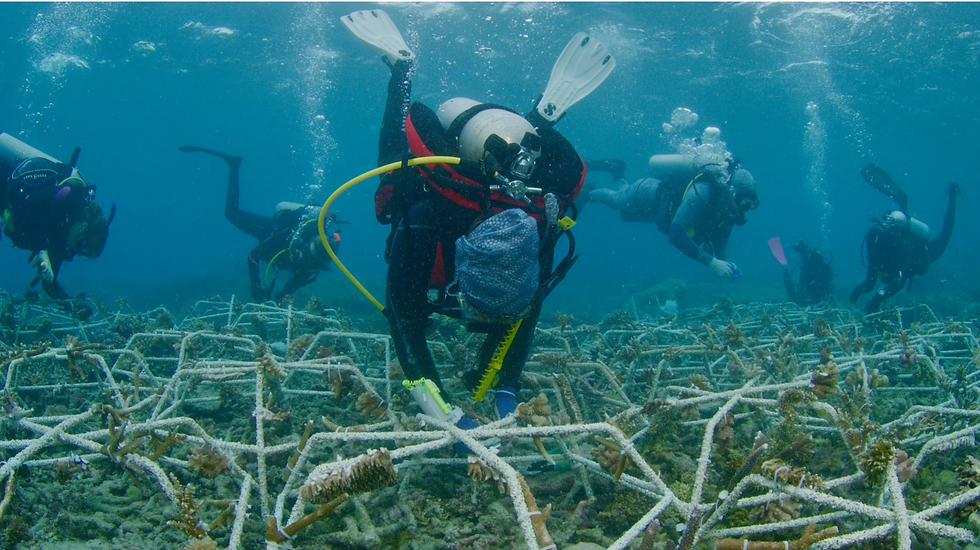
Hexagonal ‘Reef Stars’ (Credit: SHEBA®)
To all intents and purposes, one thing we can be virtually certain of is that we really need to ditch the practice of dumping wastes into the sea as artificial coral reefs substrates. Frankly speaking, such a substandard method is overtly unjust for our corals, introducing deleterious adulterations into the sea along the way. On the other hand, tried-and-true thoughtfully manufactured scaffolds are surefire modality that come along and soar on.
Sustainability in the Long Run
Now that science has offered adequate solutions on restoration, we are relieved to have hit our strides at the moment. Yet, the requirement for manufacturing new scaffold substrates often means that building up artificial coral reefs will be a mere workaround in lieu of a long-term solution. In effect, only when we collectively synergise to halt global warming and climate change then can we nip the conundrum of coral bleaching in the bud - prevention is better than cure and such. Itching closer to our overarching objective in sustainability, it is incumbent upon us to cut down our greenhouse gas emission. On a large scale, there is no gainsaying that quests and state-of-the-art advancements in renewable energy are a must, since burning fossil fuel is the greatest culprit of human-induced climate change. The sooner we get hold of renewable energy, the sooner we can cast away fossil fuel combustion, once and for all. Likewise, the corporate realm is exhorted to embrace net zero practices and minimise its carbon footprint, contributing towards Corporate Social Responsibility (CSR) along the way. As individuals, our roles should not be undermined either. With this in mind, the whole idea can be as rudimentary as curtailing your use of air-conditioners besides switching off the lights whenever possible, and, the corals will thank you. After all, when we cut back on electricity consumption, we are, in earnest, solemnly discouraging the combustion of fossil fuels - since energy production dwindles when demand ceases. You might be thinking, a single urban dweller’s independent effort may seem too minute to be noticed. Nonetheless, we should never neglect what our coral friends have shed light on us - tens of billions of coral polyps add up to become a reef, despite the minuscule facade of each coral unit. Similarly, it’s in fact our collective effort that will turn out to be a massive strength modulating our green future when everybody tunes in and stands in solidarity with a common goal - sustainability. Ultimately, every fraction of a degree matters, every voice can make a difference, and, every second counts.
References
Baptiste Ozanam, Romans, P. and Lami, R. (2025). Choosing the right substrate to restore coral reefs through artificial reef construction: a mini-review. Blue Biotechnology, 2(1). doi:https://doi.org/10.1186/s44315-025-00047-5.
Helgoe, J., Davy, S.K., Weis, V.M. and Rodriguez‐Lanetty, M. (2024). Triggers, cascades, and endpoints: connecting the dots of coral bleaching mechanisms. Biological Reviews, 99(3). doi:https://doi.org/10.1111/brv.13042.
Perera, F. (2017). Pollution from Fossil-Fuel Combustion is the Leading Environmental Threat to Global Pediatric Health and Equity: Solutions Exist. International Journal of Environmental Research and Public Health, [online] 15(1), p.16. doi:https://doi.org/10.3390/ijerph15010016.
This article was prepared by Low Yi Xian (UTAR)
Comments